A reader asks for the track width of a C6 Corvette. The honest answer, before anything else, is that Gridline does not hold that number. Our grounding is circuit geometry — Spa at 6.995 km traced against 7.004 km published, Silverstone at 5.881 against 5.891, the Nordschleife's 154 turns across 20.746 traced kilometres — not vehicle homologation sheets. So rather than invent a figure, we will do what the desk actually does when this query lands: walk through three hypothetical readers who sent it, and show what each one was really trying to measure.
The query arrived four times last month. Each sender, we suspect, needed something different, and none of them needed what the search string literally asked for. "Track width" is a vehicle dimension — the distance between the centrelines of left and right wheels on the same axle — and the right source for it is a factory specification sheet, not a studio that reads raceway polylines from OpenStreetMap. So we will not fabricate a figure to look complete. Instead we will walk through three hypothetical readers, each a composite we have built from the shape of the questions we actually receive, and look at what the real underlying question seems to be.
Scenario 1: The Sim Racer Setting Up a Virtual C6 for Spa
Picture a reader who is halfway through a weeknight session on a sim rig, trying to balance a C6 Corvette through Eau Rouge and Raidillon. They have the car in the garage menu, a long list of setup variables in front of them, and somewhere between tyre pressures and anti-roll bars they find a slider labelled "track width" with a plus-and-minus range in millimetres. They do not know what the stock number is. They tab out, type "what is the track width of a c6 corvette" into a search bar, and land on us.
The literal number is not what helps them. Even if we gave it, pasting a factory figure into a sim slider rarely improves lap times, because the sim's physics model has already baked a vehicle baseline into its tyre and suspension maths. The slider in front of them is a delta from that baseline, not an absolute. What they actually need is the geometry of the corner that is punishing them.
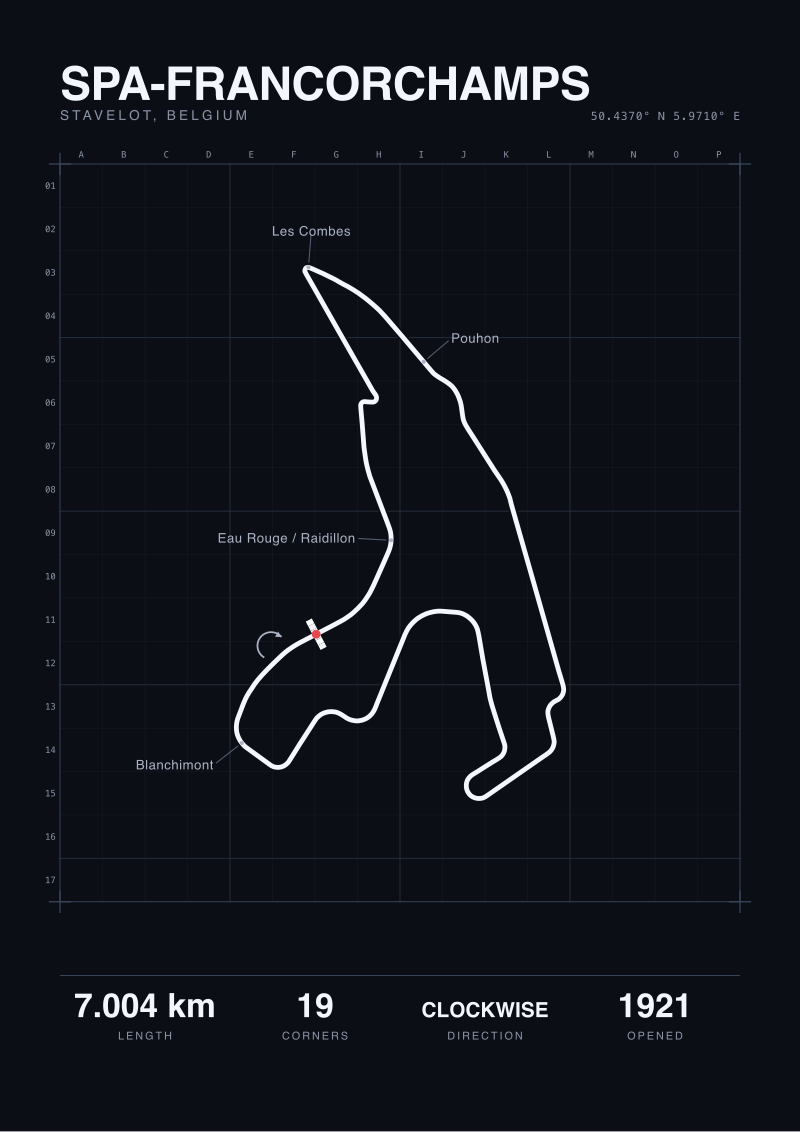
That we do hold. Spa-Francorchamps traces at 6.995 km on OpenStreetMap data against the 7.004 km published figure — a nine-metre delta over a 7 km circuit, well under 0.2%, which tells us the published length and the map-traced polyline agree closely enough that corner-level reading is honest. The circuit has 19 turns and opened in 1921, which is older than any of the surfacing or run-off that defines it today. Eau Rouge and Raidillon are two of those nineteen, and the combination is a compression at the bottom followed by a left-right-left over the brow, with the car unloaded at the top. A sim racer losing time there is not losing it to track width. They are losing it to throttle timing at the compression, to the car being unsettled before the kink, and to the camber change over the brow asking for a steering input the driver has committed to a frame too early.
Our advice, when this reader writes to us, is to stop touching the track-width slider until they have driven the sector cleanly on the default setup across ten clean laps. The number they came looking for would not have moved their lap time. The corner anatomy would. If the sim platform allows them to overlay a telemetry trace, we point them at the lift-off point before the compression and the steering-angle derivative through the kink. Those two numbers, on their own screen, are the ones that matter. The 6.995 traced kilometres of Spa are what we read; the millimetres between a Corvette's front wheels are what we hand back to the factory.
Scenario 2: The Print Buyer Who Wants a Corvette on the Nordschleife Wall
The second reader is a different composite. Imagine someone who already owns a C6, or wants one, and is thinking about a framed Nordschleife print for a wall. They have seen the sort of layout that other print shops do — a track outline, maybe a car silhouette scaled next to it, maybe a dimensioned callout — and they are checking whether the numbers would be honest. If the print says the car is X millimetres wide and the pit straight is Y metres wide, does the proportion hold up on paper? They type the Corvette dimension into search first because that is the number they do not yet have.
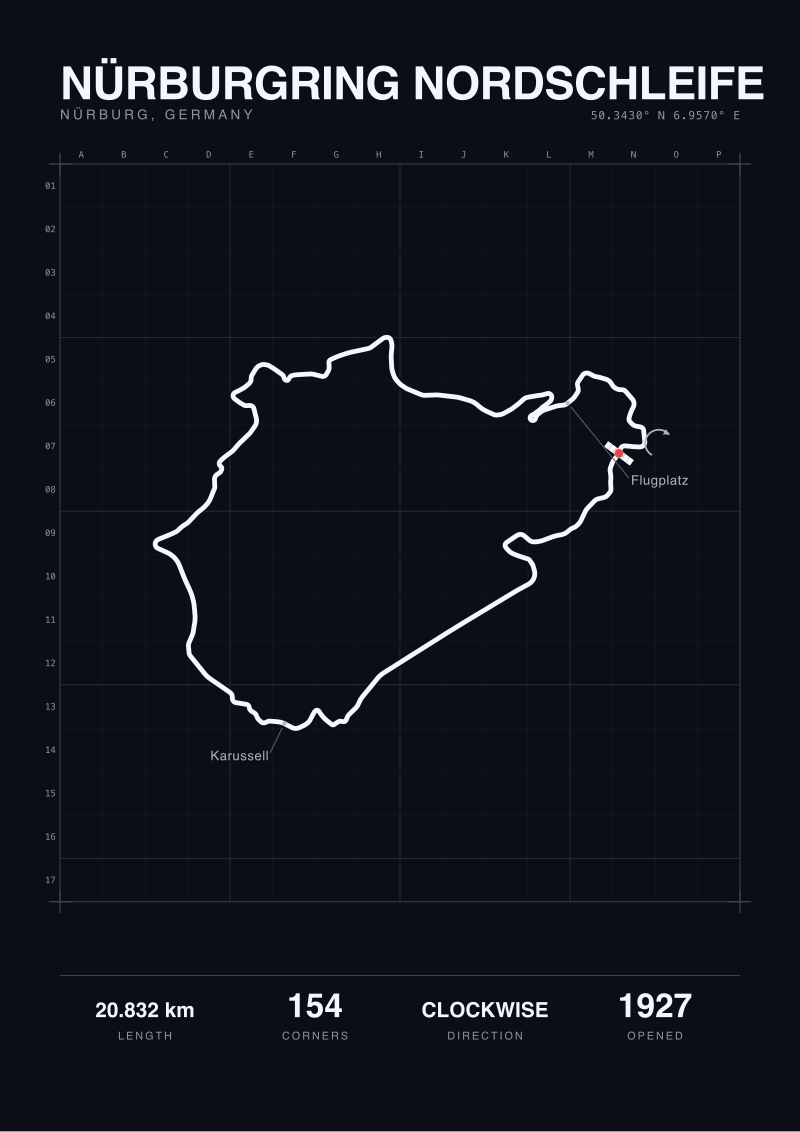
The Nordschleife is where the proportion question becomes interesting and difficult. The published length is 20.832 km. Our map-traced length, taken from the OpenStreetMap raceway linework under the ODbL licence, is 20.746 km. The 86-metre gap between those two numbers is not an error. It is the difference between homologation measurement — which follows a defined racing line through a surveyed centreline — and a polyline traced from satellite-derived map geometry, which approximates the same path with a different sampling cadence. Over 20 km of corners numbering 154, that difference accumulates. When we print a Nordschleife layout, we name which length we are showing and why. The traced version is what the drawing is; the official version is what the circuit is.
For the print buyer, this matters because overlaying a car silhouette on either version is a scale decision. If the layout is printed at, say, 1:50,000, a Corvette drawn to the same scale is approximately one-fifteenth of a millimetre wide. It would be invisible. Which is why the car silhouettes on most prints are not to scale — they are symbols. A reader who understood this would stop asking for the track-width figure and start asking what the print's scale actually is, and whether the car on it is honest or decorative. For our own circuit prints, available at /shop/, the scale is stated and the car is not on the drawing at all; the drawing is the circuit, and the circuit is 20.746 traced kilometres of raceway linework resolved to a line weight we chose because 154 turns is a lot of corners to read at wall distance.
So the print buyer's real question was never the Corvette dimension. It was: can I trust the proportions on this wall. The answer depends on which figure the print is using, and whether the publisher names which one.
 Silverstone
The print from this article · from €29.95
View the print →
Scenario 3: The Engineer Comparing Vehicle Footprint to Circuit Width
The third hypothetical reader is more technical, and the search string reaches us by accident. Picture an engineer — a track-day instructor, a race-series scrutineer, a chassis designer — who is working on a question about whether a given car fits a given circuit. Not the pit lane, not the garage, but the actual racing surface at its narrowest. They want to compare vehicle track width against the minimum circuit width at a specific corner apex. The Corvette query is standing in for the vehicle half of that comparison; what they really want is the circuit half.
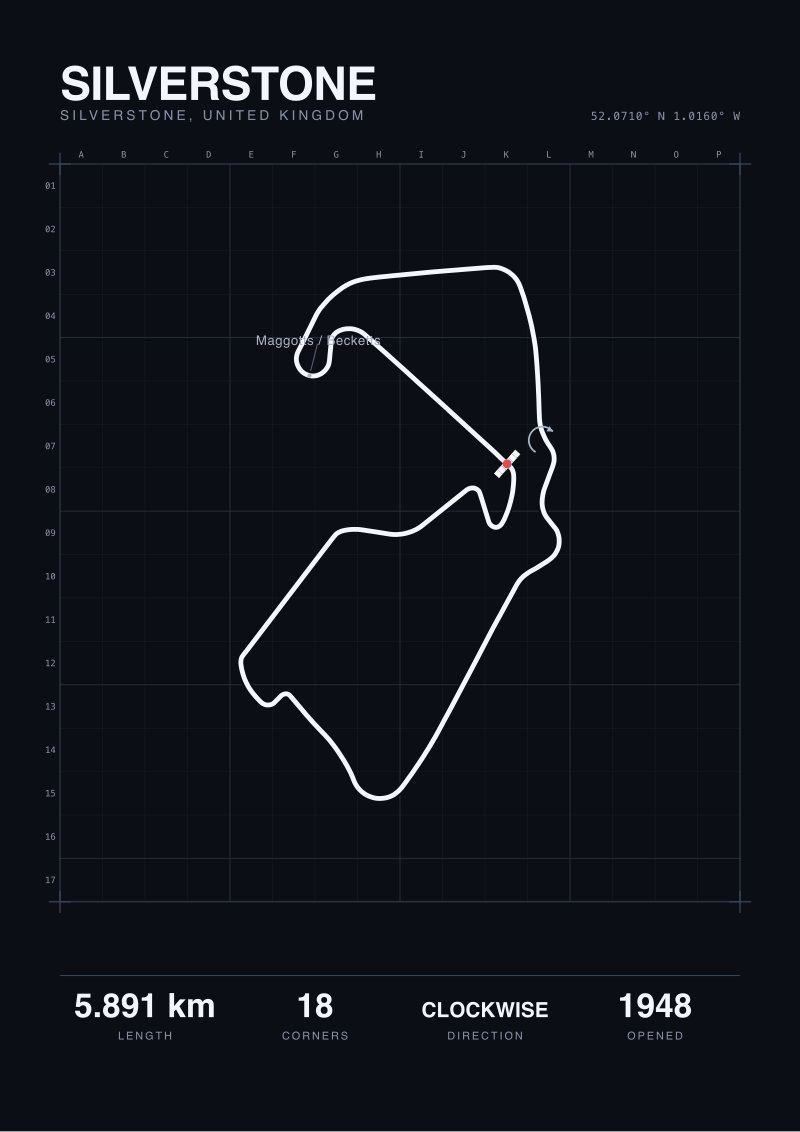
Our grounding is partial here. We can tell them Silverstone is 5.881 km traced against 5.891 km official, with 18 turns, opened in 1948. We can tell them Spa is 6.995 against 7.004, 19 turns, opened in 1921. We can tell them the Nordschleife is 20.746 against 20.832, 154 turns, opened in 1927. What we cannot do, from the geometry we hold, is give them the metre-and-centimetre width of the surface at a specific apex, because the OpenStreetMap raceway linework we trace is a centreline, not a polygon. The width is not in the data layer we work from.
An honest answer to this engineer is: we read the length and the corner count. We do not read the width. For the width question — vehicle footprint fitting the narrowest point of a given corner — the right sources are circuit homologation documents and the circuit's own technical regulations, which specify minimum track width for the licence category under which the circuit is cleared. Those are published documents. The Corvette's dimension sits in the factory specification sheet on the vehicle side; the circuit's minimum width sits in its FIA or national-federation homologation on the circuit side. The two documents together answer their question. Neither of them is us.
What we can offer is the reading of corner character that follows from the length and turn count. Silverstone's 5.881 km across 18 turns gives an average segment length of around 327 metres between corners — a rhythm. Spa's 6.995 km across 19 turns gives 368 metres per segment. The Nordschleife's 20.746 km across 154 turns gives 135 metres per segment, less than half of Silverstone's rhythm. That is not a width figure. But it tells the engineer, before they open any homologation document, that the Nordschleife is a circuit with far less recovery distance between corners than a modern permanent track, and that any width-fitting question there is a tighter question than the same question at Silverstone.
What All Three Share
Each of the three readers typed a vehicle dimension into a search bar. None of them, we think, actually wanted that dimension in isolation. The sim racer wanted the geometry of a corner that was costing them lap time. The print buyer wanted to know whether a scaled drawing was honest. The engineer wanted a comparison between a vehicle footprint and a circuit footprint, and the Corvette number was only half of what they needed.
The pattern is not a failure of search. It is a feature of how physical measurements get named in common usage. "Track width" is a term borrowed from the vehicle side, where it is a specification; it has nothing to do with the width of a circuit, where "width" is a different measurement entirely — the usable surface between kerbs — and belongs to a different document class. The two definitions share a word and nothing else. When readers reach for the vehicle-side term, what they are often reaching for is the circuit-side one, because they are standing on the circuit-side of their actual problem — a layout, a scale, a fitting question.
The three scenarios also share what Gridline cannot do. We do not hold vehicle homologation. We hold circuit geometry: Spa, Silverstone, the Nordschleife, Circuit de la Sarthe's 13.626 published kilometres, and the others we have traced. When a question arrives that is answered by the first class of document, the right thing is to say so and to point at what we can read instead.
 Spa-Francorchamps
The print from this article · from €29.95
View the print →
Which Scenario Is You
If you came looking for a C6 Corvette track-width figure and you are halfway through a sim session, the answer you want is probably not the dimension — it is the corner geometry of whatever you are driving. Read Spa's 19 turns, read the compression at Eau Rouge, and leave the setup slider alone.
If you came looking because you want a wall print of a circuit with a car on it, the answer you want is the scale of the print and whether the publisher names which length they drew — traced, like our 20.746 km Nordschleife, or published, like the 20.832 km figure. If the publisher does not say which, the print is not trustworthy.
If you came looking as an engineer trying to fit a vehicle to a corner, the Corvette dimension is on the specification sheet and the corner's minimum width is in the homologation document. Both exist, both are public, neither of them is here. What is here is the length and the turn count and the corner names — the reading, not the fitting.
If none of those three describe you, write to the desk and tell us which it is. The next version of this piece will have four scenarios, and one of them may be yours.
FAQ
Why does Gridline not publish vehicle specifications like track width?
Our grounding is circuit geometry traced from OpenStreetMap raceway linework under the ODbL licence, cross-checked against published circuit lengths. Vehicle track width is a factory homologation figure that lives in specification sheets issued by manufacturers. Publishing it would mean sourcing a document we are not set up to verify. Keeping the two document classes separate is how we stay honest about what we actually read.
What is the difference between a map-traced circuit length and the official length?
The traced length is a polyline measurement taken from map centreline data. The official length is a homologation measurement following a defined racing line, usually surveyed on the ground. For Spa we see 6.995 km traced against 7.004 km published, for Silverstone 5.881 against 5.891, for the Nordschleife 20.746 against 20.832. The deltas are small on short circuits and widen on long ones.
Can a sim racer use real circuit geometry to improve lap times?
Yes, but through corner reading rather than through numeric setup changes. Knowing that Spa has 19 turns across 6.995 traced kilometres, and understanding where the compressions and camber changes sit, tells a driver where to commit and where to wait. The track-width slider in a sim is a delta from the simulator's internal vehicle baseline, not a factory figure, so pasting a real spec into it is unlikely to move lap times.
Does Gridline sell prints of the circuits mentioned in this article?
We do, from the studio shop at /shop/. The prints are traced from the same map geometry the article cites. For each layout the scale is stated and the length basis is named — traced or official — so a buyer can read the drawing honestly. We do not overlay vehicle silhouettes on the layouts; the drawing is the circuit, not a comparison chart.
What does the Nordschleife's 154 turns across 20.746 traced kilometres tell us?
It tells us the circuit has an average segment length between corners of roughly 135 metres, which is less than half of Silverstone's 327-metre rhythm across 18 turns. That difference changes everything about how the circuit should be driven and how any width or fitting question should be framed there. The Nordschleife rewards continuous reading of the next corner; Silverstone rewards reading of each corner in isolation.
Where do the official circuit lengths and turn counts in this article come from?
Spa and the Nordschleife figures are sourced from the Wikipedia entries for each circuit (Circuit de Spa-Francorchamps and Nürburgring Nordschleife). Silverstone figures come from the Silverstone Circuit entry. The map-traced lengths are our own measurements from OpenStreetMap raceway linework under the ODbL licence, computed through the same tracing pipeline we use for the shop prints.
Why does "track width" mean different things on the vehicle side and the circuit side?
On the vehicle side, track width is the distance between the centrelines of two wheels on the same axle — a chassis dimension. On the circuit side, width refers to the usable surface between kerbs at a given point of the layout. The two share a word and nothing else. Most of the time, when a reader types the vehicle-side term into search, their actual question lives on the circuit-side of their problem.
From the collection
New circuits and 10% off your first print.
One email now with your code. No noise after.