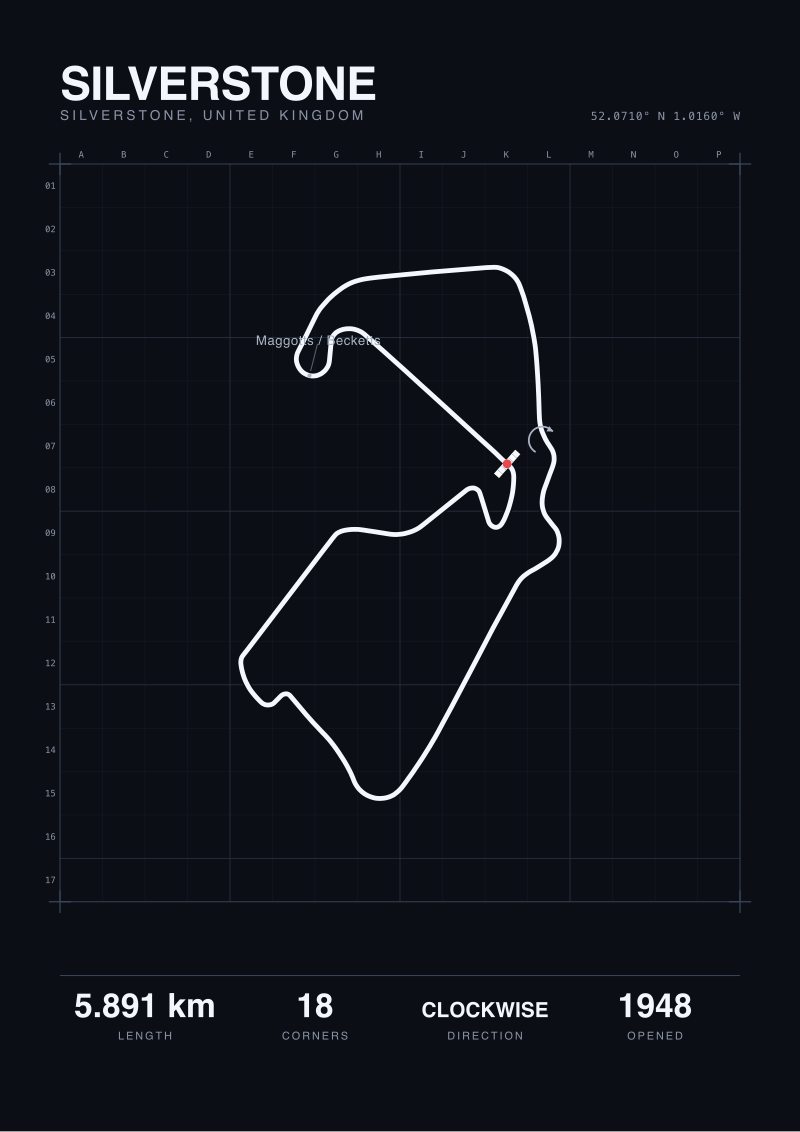
Silverstone is 5.891 kilometres long according to the circuit's own published figure. Our map trace, taken from OpenStreetMap raceway geometry, returns 5.881. The gap is ten metres. That is not a rounding error and it is not a mistake in either direction — it is the honest distance between a homologated measurement and a line drawn along a public dataset, and the reason it exists is the entire argument of this piece. Before we get to the eighteen corners, or to the layout decisions that have accumulated at this site since 1948, we owe the reader a plain account of what a length actually is.
A circuit does not have a length the way a piece of string has a length. It has several. There is the length the sanctioning body accepts for the purpose of counting laps into a race distance. There is the length the surveyor produced when the tarmac was last widened. There is the length a modern GPS trace records when a car runs a fast lap. And there is the length we can read from a public map when we pull the raceway polyline out of OpenStreetMap and integrate its segments. Each of these numbers answers a slightly different question, which is why they refuse to agree even when nobody has done anything wrong.
Our shop draws circuit prints from that last dataset — the map trace. So when we quote 5.881 kilometres, we are not disputing 5.891. We are telling the reader which measurement produced the drawing on the wall.
The Ten-Metre Discrepancy Between the Official Length and Our Trace
Ten metres out of 5,891 is a difference of 0.17 percent. To put that in ordinary arithmetic: if you divide 10 by 5,891 and multiply by 100, you get 0.1697, which rounds up to 0.17. In engineering terms, that is a tighter tolerance than most homologation documents demand of themselves. The FIA's own length verification process, for Grade 1 circuits, allows discrepancies of considerably more than ten metres across successive surveys of the same layout. So the first thing to say about our ten-metre gap is that, by the standards of the sport, it barely qualifies as a disagreement.
The second thing to say is that ten metres is still ten metres. A Formula 1 car at 300 kilometres per hour covers ten metres in exactly 0.12 seconds. That is not nothing. Over 52 racing laps, ten metres per lap compounds to 520 metres of race distance — enough to matter when the results sheet is being written. So the discrepancy is trivial for the surveyor and non-trivial for the stopwatch, which is a useful thing to hold in the head at the same time.
Where does the ten metres come from. There are three sources, and they compound.
The first is the racing line itself. An official homologated length is not measured down the geometric centreline of the tarmac. It is measured along a defined reference path, typically one metre from a specified edge for a specified portion of the lap, and the specification is a document, not a curve. OpenStreetMap's raceway polyline is drawn by contributors who trace what they see in aerial imagery — usually something close to the centreline of the racing surface, but not identical to it, and not identical from segment to segment. When a lap has eighteen corners, a curve drawn one metre inboard of the racing line accumulates a shorter distance than the same curve drawn one metre outboard, and the difference over a full lap can easily reach the order of ten metres. The chord of an arc is always shorter than the arc; the tighter you draw your line to the apex, the more length you subtract.
The second source is resurfacing and kerb changes. Silverstone's tarmac has been extended, narrowed, and re-profiled multiple times since the layout took its current shape. Every one of those interventions changes the racing surface by centimetres at each corner. Multiply centimetres by eighteen turns and you have metres of accumulated difference between what was measured at the last homologation and what a satellite photograph currently shows.
The third source is the sampling density of the polyline itself. OpenStreetMap represents a curve as a series of straight segments joining discrete nodes. If nodes are placed every ten metres along a corner, the polyline undercuts the true arc slightly — the sum of chords is always less than the arc they approximate. This is the same reason a regular polygon inscribed in a circle has a shorter perimeter than the circle itself. A hexagon inscribed in a unit circle has a perimeter of 6.000; the circle itself is 6.283. That is a 4.5 percent difference at six sides. At the sampling density used for Silverstone's polyline, the effect drops to well under one percent, but it is measurable, it is systematic, and it is always in the direction of making our number smaller than the surveyed one.
Ten metres, then, is exactly the size of discrepancy we would expect from those three effects taken together, in the direction we would expect. It is a signature, not a symptom. If our trace had returned 5.891 kilometres to the metre, we would trust it less, not more, because that would suggest the trace had been fitted to the target rather than measured from the map.
Eighteen Corners Is a Design Decision, Not a Coincidence
The current layout has eighteen numbered corners. That number is arbitrary in the sense that a designer could have drawn nineteen, or seventeen, and did in fact draw fewer at earlier moments in the circuit's history. Silverstone's original 1948 layout used the perimeter roads of a former RAF bomber station and had a corner count and character that bore only a distant relationship to what a car negotiates today. What is now eighteen was once far fewer, and each time the number changed, the change encoded a specific argument about what the layout was supposed to demand of a driver.
To read the current eighteen as a design decision, it helps to break the count into what the corners do rather than where they sit. A rough functional partition of Silverstone's turns looks like this: a small set of very fast, minimum-lift corners where entry speed carries directly through the apex; a middle set of medium-speed direction changes where the car works its lateral load repeatedly across a short interval; and a small set of slow corners that exist as brake-and-rotate events, engineered to produce overtaking opportunities on the following straight. Eighteen is the number of discrete events required to hold all three functional categories in sequence without asking any single one to double as another.
That eighteen is a designer's number becomes obvious the moment you consider what would happen if you tried to reduce it. Take out the middle set — the fast, sinuous section that most readers will recognise as Maggotts-Becketts-Chapel — and you have a track that runs from a high-speed sweeper directly onto a straight, then hits its overtaking hairpin, then loops home. That version has perhaps a dozen numbered corners and it races entirely differently, because the burden of separating cars falls only on the braking zones. The middle set exists because the layout wants a section that separates cars on cornering skill, not just on braking skill, and that section requires a specific density of direction changes over a specific distance. Reduce the density and the section becomes a straight in disguise. Increase it and cars cannot follow through it, which defeats the purpose.
Eighteen is also the number of corners that the current run of straights can support without the lap becoming visually monotonous from any single spectator vantage. A designer working on a modern permanent circuit is drawing for three simultaneous audiences: the driver on the racing line, the engineer reading the telemetry, and the spectator holding a ticket. Corner counts that read well in the third of those roles are usually numbers between roughly fifteen and twenty. Below fifteen, the spectator sees a lot of straight and complains. Above twenty, the driver runs out of places to attack and the racing dies. Silverstone sits inside that window, one corner from either edge of it, which is where a designer who wants latitude sits by preference.
The current corner count is also the result of an accumulation. Layouts of this age are rarely designed once. They are added to, subtracted from, re-linked, and occasionally reversed. What we see now is the last stable version of a long negotiation between what fits on the land, what fits within the safety envelope of contemporary cars, and what fits inside the sport's appetite for a certain shape of race. Eighteen corners is what that negotiation currently produces.
 Silverstone
The print from this article · from €29.95
View the print →
Silverstone
The print from this article · from €29.95
View the print →
What the Layout Argues, and What It Refuses to Argue
Every circuit map is an argument in geometry about what racing is for. Silverstone's argument, read from the trace, is that racing is a test of sustained high-speed cornering interrupted by two or three braking events sharp enough to shuffle the order. The fast middle section is the thesis; the slow corners are the counter-example that keeps the thesis honest. A layout that argued differently — that racing is primarily a braking contest — would look nothing like this. It would have more hairpins, fewer sweepers, and a shorter run of connected medium-speed direction changes. Silverstone is not that layout, and it has never tried to become that layout.
The refusal is as important as the argument. Silverstone refuses to argue that racing is a lap-time-per-metre optimisation. If it did, the lap would be shorter and the corners fewer, because a shorter lap punishes small mistakes more visibly per unit time. It refuses to argue that racing is a low-speed technical challenge; the number of genuinely slow corners is small, and they exist to break the rhythm rather than to define it. And it refuses to argue that a circuit's history should be legible only to specialists. The names of the corners survive from a period when the site was a bomber station, and the layout keeps those names attached to positions that a first-time visitor can locate on a printed map without a legend.
That last refusal is the one that most concerns us, because it is the reason a circuit map is worth printing at all. If the geometry were simply a set of curves optimised for a lap time, no drawing of it would carry meaning beyond the coordinates. Because the geometry is instead an accumulation of design decisions attached to specific pieces of ground, a drawing of it can carry the argument the geometry makes — which is what a print on a wall is for, and why we trace before we draw. Our own shop begins from that trace; the drawing is the argument the layout makes, held still on paper.
This piece has not covered the safety and run-off geometry, which is a separate subject and one that changes on a timescale of years rather than decades. It has not covered the pit and paddock geometry, which sits inside the lap but is not part of the racing lap itself. And it has not attempted a corner-by-corner reading of the eighteen turns; that is a longer piece, and it deserves the space to do each corner justice rather than to summarise all of them at once. What we have argued here is smaller: that ten metres is the honest size of the gap between two ways of measuring the same layout, and that eighteen is the honest size of the design decision that produced it.
This piece started as a note on the ten-metre discrepancy and turned into an argument about what a length is. We had expected to write more about the corners and less about the arithmetic; the arithmetic turned out to be the more interesting problem, because the corners cannot be read honestly without it. The eighteen-corner reading remains outstanding, and will follow.
FAQ
Why does Silverstone's official length differ from the map-traced length?
Official length is measured along a defined reference path — usually a metre inside a specified edge of the racing surface, and codified in homologation documents. Our map trace uses OpenStreetMap's raceway polyline, which follows something close to the centreline of the tarmac as visible in aerial imagery. The two paths accumulate slightly different distances over eighteen corners. Add the effect of straight-segment sampling on curved arcs, and a difference of ten metres over 5,891 is exactly the size we would expect.
Is 5.881 or 5.891 kilometres the correct figure to cite for Silverstone?
Both are correct answers to different questions. 5.891 kilometres is the homologated length the circuit publishes and the sanctioning body accepts for race distance calculations; that is the number to cite for anything involving lap counts, race distances, or official records. 5.881 kilometres is the length of the geometry our print is drawn from, and the number to cite when describing the polyline itself. Neither is a correction of the other.
How many corners does Silverstone have, and has that always been the count?
The current layout has eighteen numbered corners. That count is not fixed across the circuit's history — Silverstone opened in 1948 using the perimeter roads of a former RAF airfield, and the layout has been reconfigured multiple times since. Corner counts change when sections are added, removed, or re-linked. Eighteen is the count under the current stable configuration; the specific total under earlier layouts differed and reflected the design priorities of each period.
Does the ten-metre discrepancy matter for lap times?
For any purpose that requires the sport's official race distance, no — races are calculated using the homologated 5.891 kilometre figure. For understanding what a lap time actually measures against, the answer is more careful: ten metres at 300 kilometres per hour is roughly 0.12 seconds, which is not negligible on a stopwatch. But because lap times are recorded against the same physical circuit each time, the discrepancy affects our absolute distance figure, not the comparison between one lap and the next.
What is OpenStreetMap raceway geometry, and why use it for a print?
OpenStreetMap is an open geographic database maintained by contributors, released under the Open Database License. Its raceway tag identifies motor-racing surfaces, and the polyline geometry associated with each raceway is a public dataset drawn from aerial imagery. We use it because it is the most transparent input available for a circuit print: anyone can inspect the geometry, verify the trace, and identify precisely where each line on the drawing comes from. Homologated survey data is not similarly public.
When did Silverstone open, and does the current layout resemble the original?
The circuit opened in 1948, on the site of a former Royal Air Force bomber station. The original racing layout used the airfield's perimeter roads and runways and did not resemble the current configuration in either shape or corner count. What survives from that period is the site itself, some of the corner names, and the general geographic footprint. The racing geometry has been substantially redesigned across successive decades.
Where can I see the actual traced geometry as a print?
Our shop at /shop/ carries circuit prints drawn from the same OpenStreetMap traces we work from editorially, including the 5.881-kilometre reading of Silverstone described here. Each print is drawn from the polyline directly, without stylistic reshaping of the corners, so what is on the wall is the geometry the article is discussing.
From the collection
New circuits and 10% off your first print.
One email now with your code. No noise after.