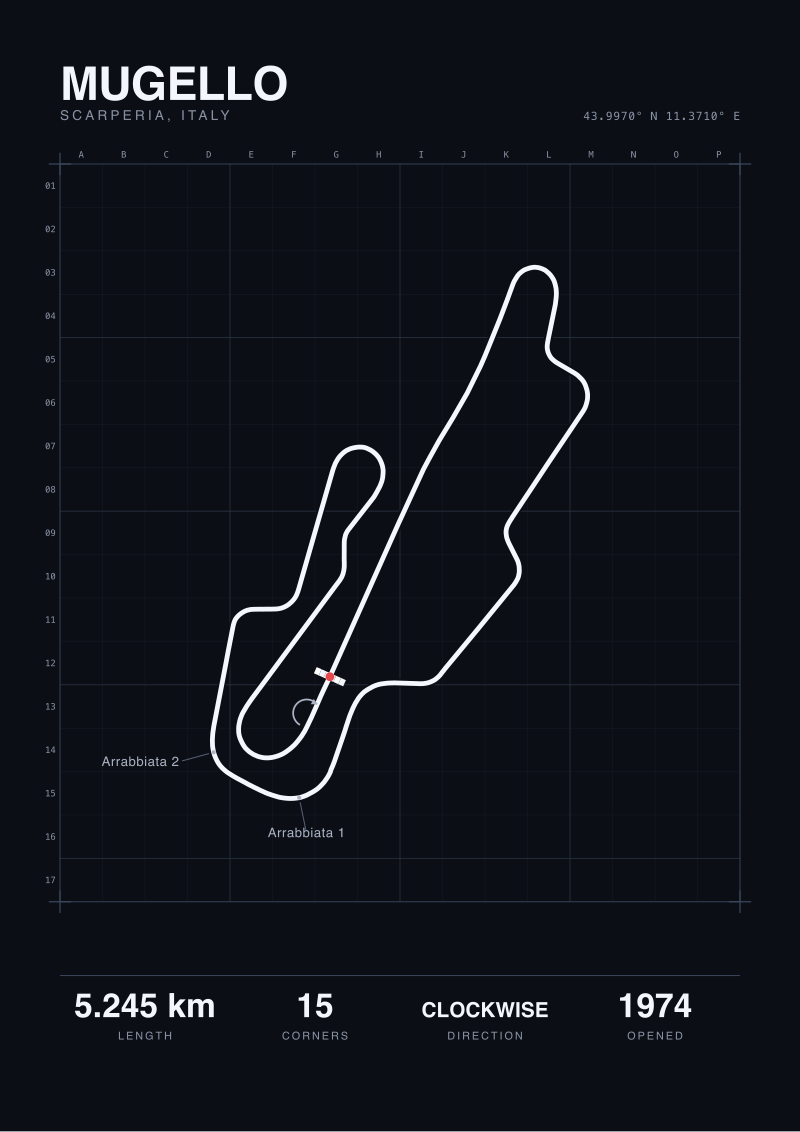
Five point two four five kilometres. That is the number printed under the drawing of the Mugello circuit in Scarperia, and it is the same figure the circuit publishes as its official length. It is not, in this case, a coincidence: our traced geometry, pulled from OpenStreetMap's raceway data under ODbL, closes on the same 5.245 km the operator homologates. That agreement is unusual enough to be worth explaining, and it is the cleanest place to start a walkthrough of how a Mugello print is drawn — what the line is, what the fifteen corners are, and what the sheet is deliberately not showing.
Where the 5.245 km on the sheet actually comes from
The line that appears on a Mugello print is not a stylised curve. It is a vector export of a real polyline, held in OpenStreetMap under the raceway tag and released under the Open Database Licence. Contributors have surveyed and re-surveyed the Scarperia hills using aerial imagery and GPS traces, snapping the ribbon of the circuit to the centreline of the tarmac. When we pull that polyline into the studio, the first thing we do is measure it. Not eyeball it — measure it. Segment by segment, the polyline returns a total distance, and for Mugello that total is 5.245 km, matching the official homologation to the metre.
That level of agreement is worth naming, because it is not always the case. Circuit length as a published figure is a legal-technical number: it comes out of the FIA homologation document, and it is measured along a defined racing reference — typically the centreline, sometimes a nominal driving line, sometimes an offset the circuit's engineers chose when the layout was signed off. The number on our sheet, by contrast, comes out of a map database that a community keeps up to date from images and ground truth. On tracks that have been resurfaced, re-kerbed, or subtly re-drawn since their last homologation, those two measurements can diverge by tens of metres. Mugello, opened in 1974 and remarkably stable in layout since, sits inside a tolerance where both numbers land on 5.245.
We print the number we can defend. When they agree, we say "5.245 km — official and traced." When they disagree, we say which one we are showing, and why. The sheet is not the place to hide that decision.
The 15 corners, and why we count them the way we do
The other headline number on the print is fifteen. Fifteen turns. That figure, like the length, comes from the homologation record and matches what the circuit itself publishes. It is not a suggestion. It is a count made under a specific convention, and the convention matters.
A corner, for the purposes of a homologated turn count, is a direction change the layout designers marked out as a discrete feature — usually one they gave a name to. On the Mugello sheet, that count includes the compound sequences as separate turns rather than folding them into a single "esses" block. The two Arrabbiata corners are two turns, not one, because they were signed off as two. Casanova and Savelli, running together as a flowing right-left, are counted as two even though a driver reads them as a single line. The count is a document, not a driving instruction.
We label corners on the print when the audience is likely to want them. On a full-sheet studio print of Mugello, the fifteen names — from San Donato at the end of the pit straight, through the middle-sector run of Luco, Poggio Secco, and Materassi, out to the Arrabbiata pair, and back through the Bucine long right onto the straight — appear at their apex points, in a weight small enough not to interrupt the drawing. When the print is sized down for a smaller format, we drop labels and keep only the number: fifteen turns. The count survives at any scale. The name of the ninth corner does not need to.
What we do not do is renumber corners to match a driver's mental model, or bundle them to produce a "cleaner" figure. The count on the sheet is the count the FIA holds. If a reader wants to argue that Casanova-Savelli is really one corner and the true number is fourteen, that is a conversation about racing, not about the drawing. The drawing reports what the record says.
 Mugello
The print from this article · from €29.95
View the print →
Mugello
The print from this article · from €29.95
View the print →
Reading the print: line weight, orientation, and what we leave off
A circuit print is a decision about what to remove. The raceway polyline is the anchor, but around it in the OpenStreetMap data sits everything else: the pit lane, the access roads, the runoff extents, the paddock buildings, the surrounding roads through Scarperia, the contour lines of the hillside the circuit is cut into. All of it is available. Most of it does not belong on the sheet.
The rule we work to is that the print should show what the circuit is, and nothing that distracts from reading it as a circuit. That means the racing line — the polyline itself — gets the heaviest weight on the sheet, a stroke thick enough to hold the eye across the length of the paper. The pit lane is included, drawn in a lighter secondary weight so it reads as attached to the main line without competing with it. Runoff, gravel traps, and paddock geometry are not drawn. They belong on an engineering drawing, not on a studio print of the layout.
Orientation is a second decision. The convention we use is geographic north up. That is the orientation the map data arrives in, and it is the orientation a reader who has walked the circuit or looked at it from above will recognise. Some racing charts rotate the layout so the start-finish straight sits horizontally at the bottom of the page. We do not, because that rotation strips out the topographic sense of the drawing — the way Mugello sits inside the fold of the hills between Scarperia and Borgo San Lorenzo. The layout has a place. We keep the place.
Labels are the last decision. The sheet carries the circuit name, the locality (Scarperia, Italy), the year the circuit opened (1974), the traced length (5.245 km), the turn count (15), and a small legend line identifying the data provenance: OpenStreetMap raceway data, released under ODbL, with the trace measured in-studio. That legend is not decoration. It tells a reader exactly what they are looking at, and it lets anyone re-do the measurement from the same source if they want to. Provenance is part of the drawing.
Three readers, three prints: how the same drawing lands differently
The same Mugello sheet — same polyline, same fifteen labelled corners, same 5.245 km caption — reads differently depending on who is looking at it. Imagine three readers.
Picture the first as someone who has been to Mugello. They walked from the paddock up to Casanova on a MotoGP weekend, spent an afternoon watching riders lean into the compression of Arrabbiata 2, and left with the geometry of the place lodged in muscle memory. For this reader, the print is a memory device. The label at San Donato is a marker of the braking zone they watched from a grandstand. The fifteen labels do not need to be read carefully; they need to be present, in the right places, at the right shape of curve. If the geometry is wrong by twenty metres, this reader will feel it before they can name what is wrong. The measured-to-official agreement matters to them not as a technical claim but as a guarantee that the drawing corresponds to the track they stood beside.
Picture the second as a designer. They may never have seen the circuit. What they read on the sheet is the drawing as a drawing: the balance of the enclosed shape on the paper, the line weight of the polyline against the label weight, the way the compound corners produce a rhythm across the middle of the composition. For this reader, the fact that Mugello encloses a compact, roughly triangular volume — long straight down one edge, tight infield hairpin at the far end, sweeping return through the hill — is the readable content of the print. The number 5.245 is a caption; the fifteen labels are typography. What they want from us is that every one of those elements is deliberate and that nothing on the sheet is there by default.
Picture the third as someone who studies circuits for their own sake — a reader who owns a small shelf of layout drawings and reads them the way other people read old maps. For this reader, the provenance line at the foot of the print is not a footnote. It is the point. Knowing that the trace comes from OSM raceway data, that it closes to within a metre of the FIA-homologated length, and that the corner count is the count on the record, is what makes the sheet a document rather than an illustration. This reader will compare the Mugello print to a Mugello print from another studio and check where the two disagree. The whole point of our discipline is to give that reader nothing to catch us on.
Three readers, one drawing. The print does not change for them. What changes is which line on the sheet is doing the work: the polyline for the first, the composition for the second, the provenance line for the third. A drawing that serves all three at once has done its job.
Five point two four five kilometres, fifteen corners, and a hillside near Scarperia. That is the whole content of the Mugello sheet, and it is the whole reason it can be held to account. Every print of this circuit in the studio's shop is built on those three facts, drawn from that specific data source, and measured before it is drawn. The number is the number. That is what the drawing is for.
FAQ
Why does Gridline trace circuits from map data instead of using the circuit's own diagram?
The circuit's own diagram is usually a stylised rendering made for signage, television graphics, or marketing. It rarely comes with a public geometric reference we can measure, and it is often redrawn between seasons without a change note. OpenStreetMap raceway data, by contrast, is a versioned polyline released under a permissive licence, surveyed by contributors, and re-measurable by anyone. Starting from that source lets us print a number we can defend and lets a reader repeat the measurement.
Why does the traced Mugello length exactly match the official length?
Because the layout has been geometrically stable since it opened in 1974, and the OSM contributors surveying it have snapped the polyline close to the centreline the homologation uses. On less stable circuits — ones resurfaced, re-kerbed, or subtly re-drawn between homologations — the two numbers can drift apart by tens of metres. Mugello, in the version we trace, closes on 5.245 km on both counts. When that is not true elsewhere, we label the sheet with the number we are actually showing.
What does ODbL mean, and why does the print mention it?
ODbL stands for the Open Database Licence. It is the licence under which OpenStreetMap releases its data, and it requires that any published work built on that data acknowledges the source. The provenance line at the foot of the Mugello print is that acknowledgement. It also tells a reader precisely where our geometry came from, so the sheet functions as a document rather than as an unattributed illustration.
Are the 15 turns the number a driver would count, or a different count?
It is the count in the circuit's homologation record — the same figure the operator publishes. That count treats compound sequences such as the two Arrabbiata corners as two turns rather than one, because they were signed off as separate features. A driver taking the circuit may read those as a single line and mentally count fewer corners. The number on the sheet reports the record, not the racing feel.
Why is the pit lane on the print but the runoff and paddock are not?
The pit lane is part of the circuit as a layout — it is what makes the sheet legible as a working track rather than an abstract loop. We draw it in a lighter secondary weight so it reads as attached without competing with the racing line. Runoff extents, gravel traps, and paddock buildings belong on an engineering drawing, not on a studio print of the layout. Their absence is a decision, not an omission.
Why keep the print oriented with north up instead of rotating the straight horizontally?
Because Mugello sits inside a specific fold of the Tuscan hills between Scarperia and Borgo San Lorenzo, and the geographic orientation carries that. Rotating the layout to put the start-finish straight along the bottom of the page reads well in a race-broadcast graphic, but it strips the drawing of its place. The map-north orientation is the orientation the source data arrives in and the one a reader who has seen the circuit from above will recognise.
What is the one thing on the Mugello sheet a reader should look at first?
The provenance line at the foot of the print. It names the data source, the licence, and the fact that the length was measured in-studio rather than restated from a brochure. Every other element on the sheet — the polyline, the fifteen labelled corners, the 5.245 km caption — is verifiable against that line. If the provenance is missing, the drawing is decoration. If it is present, the drawing is a document.
From the collection
New circuits and 10% off your first print.
One email now with your code. No noise after.